Virtual assistant · appointments & hospital info
Built by Simplifyne Technologies
June marks the beginning of Mumbai's monsoon season, and for parents in Borivali, Dahisar, Kandivali, Mira Road, and across North Mumbai, it also marks the start of the busiest time of year at paediatric clinics. The combination of stagnant water, fluctuating temperatures, humidity, and contaminated
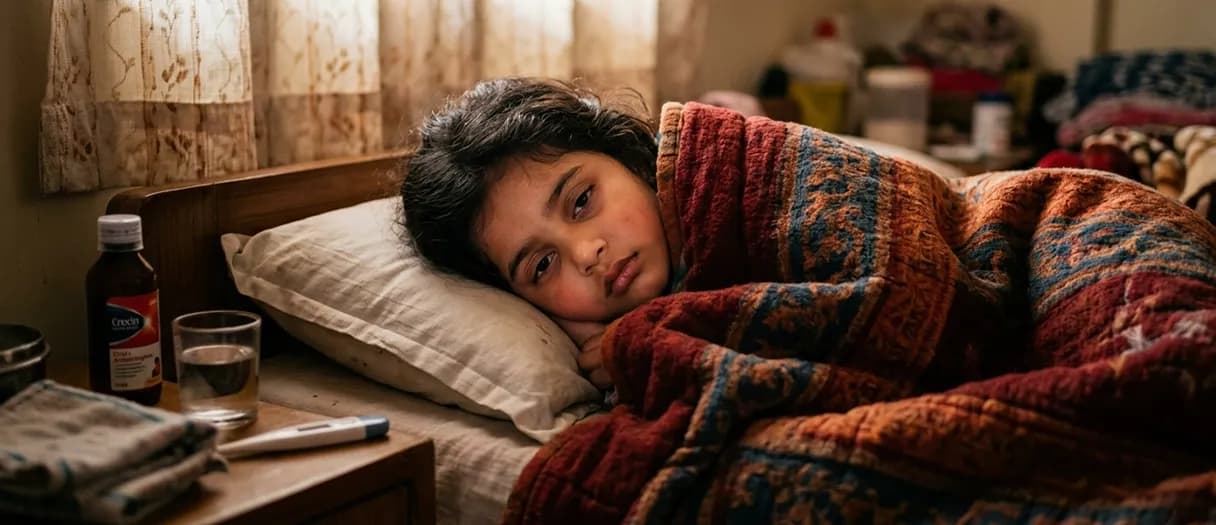
Children's immune systems are still developing, which makes them more susceptible to infections that circulating bacteria, viruses, and parasites cause during the monsoon months. In Mumbai specifically, the risk is compounded by several factors that are hard to avoid in dense urban neighbourhoods.
Stagnant water collects in overhead tanks, cooler trays, construction pits, and clogged street drains, providing ideal breeding ground for the Aedes and Anopheles mosquitoes that carry dengue and malaria respectively. Flooding during heavy rains brings floodwater that is often contaminated with rat urine, the source of leptospirosis. Food and water supplies face contamination pressure during heavy rain as drainage systems overflow. School-going children in Goregaon, Malad, and Kandivali are exposed to other children who may already be unwell, accelerating the spread of viral infections.
Understanding which illness your child may have, and when it needs hospital attention, is the most useful thing a parent can know before the season begins.
For a paediatric consultation in Borivali, visit our doctors page at Aarogyam Multispeciality Hospital
Dengue is the illness that generates the most concern for Mumbai parents every monsoon, and for good reason. The Aedes aegypti mosquito that carries it breeds in clean, stagnant water and bites during the day, including when children are in school or playing outdoors.
Symptoms in children: Sudden high fever (often above 102°F), severe headache, pain behind the eyes, body and joint aches, nausea or vomiting, and a rash that typically appears on day 3 or 4 of the illness. [Source: PAHO/WHO]
The critical window: As the fever starts to drop around day 4 to 5, some children enter a critical phase. This is when warning signs appear and a hospital visit becomes urgent.
Take your child to hospital immediately for dengue if you notice:
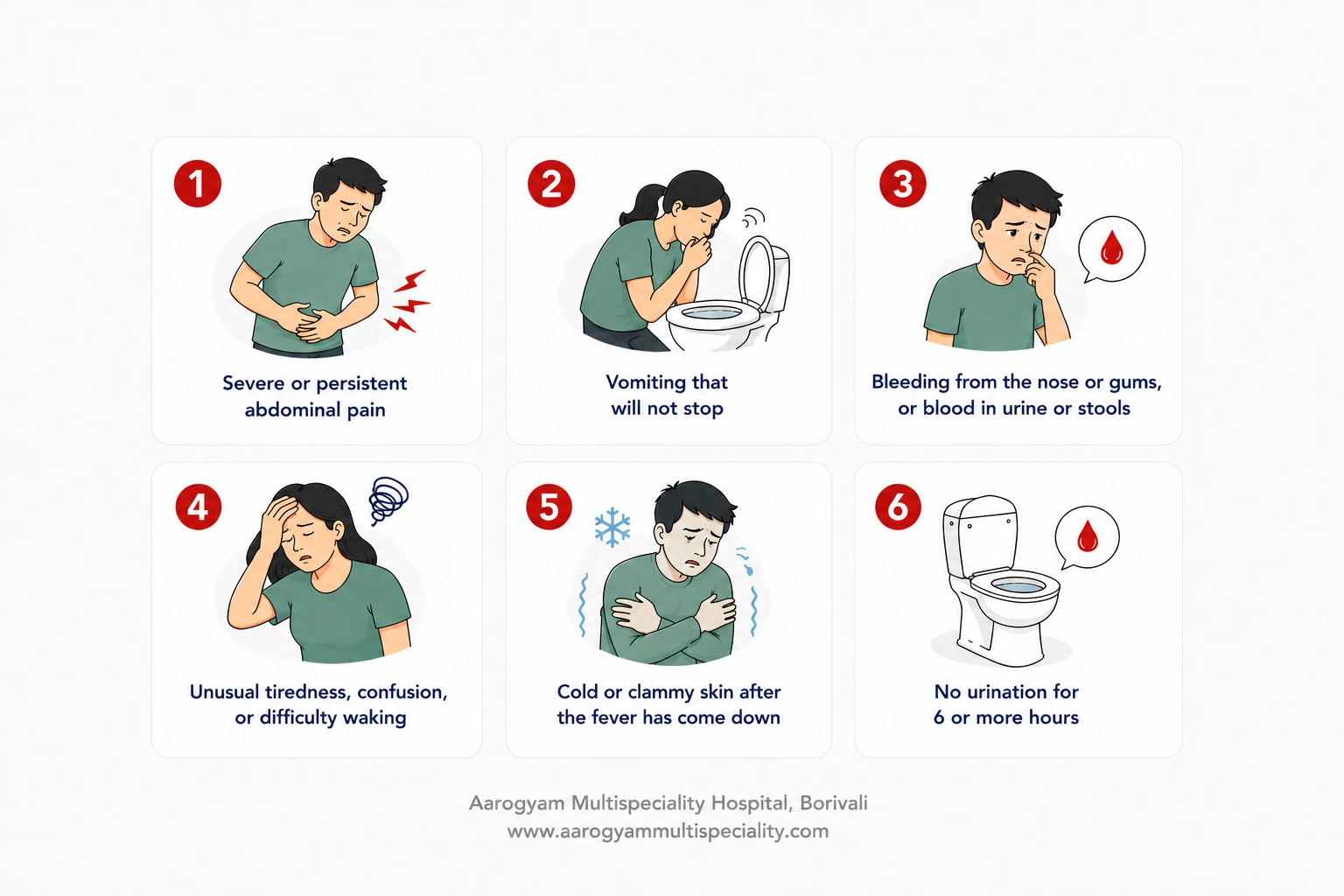
The fever going down is not a sign your child has recovered. For dengue, it may mean the critical phase is beginning. Do not wait.
Malaria is spread by the Anopheles mosquito, which bites at night. It is a consistent feature of Mumbai's monsoon disease burden. [BMC data 2025: malaria cases rose to 6,277 between January and mid-September 2025, up from 5,182 during the same period in 2024]
Symptoms in children: Fever that often comes in cycles with chills and shivering, headache, body ache, nausea, and vomiting. Younger children may not show the classic cyclical pattern and can simply present with high fever and irritability.
What to do: A blood test (peripheral smear or rapid diagnostic test) is needed to confirm malaria. Do not attempt to treat with leftover medications. Children with suspected malaria need a confirmed diagnosis and appropriate treatment under medical supervision.
Contaminated food and water are the main drivers of diarrhoea and gastroenteritis in children during the monsoon. This is particularly common in households where water supply is disrupted and food is purchased from outside. Rotavirus and bacterial gastroenteritis are both prevalent during this season.
Symptoms in children: Loose or watery stools multiple times a day, stomach cramps, nausea, vomiting, and sometimes low-grade fever.
Managing at home: The cornerstone of home management is keeping your child hydrated. WHO and UNICEF recommend oral rehydration solution (ORS) to prevent and treat diarrhoeal dehydration in children, regardless of the cause. [WHO/UNICEF Joint Statement on Clinical Management of Acute Diarrhoea] ORS sachets are available at any pharmacy. Give small, frequent sips rather than large amounts at once.
Go to hospital with a child who has diarrhoea if:
1. The child is under 1 year old
2. Diarrhoea has continued for more than 24 hours with vomiting, or more than 3 days in total
3. There is blood or mucus in the stool
4. The child appears sunken-eyed, has a dry mouth, is crying without tears, or is unusually lethargic (these are signs of significant dehydration)
5. The child is refusing all fluids
Avoid giving anti-diarrhoeal medications to children without a doctor's advice. Many are not safe for young children and can mask serious illness.
Leptospirosis is the monsoon illness many North Mumbai parents are least aware of, yet it is one of the most dangerous. It is caused by Leptospira bacteria found in the urine of infected rats and animals, which mixes into floodwater during heavy rain. Children who wade through waterlogged streets, play in puddles, or have cuts or abrasions exposed to floodwater are at risk.
Mumbai records leptospirosis cases every monsoon. BMC data from 2025 showed 143 confirmed cases in July and 72 in August alone, before the season had fully peaked. [Source: Free Press Journal / BMC data, August 2025]
Symptoms in children: Fever, body ache, chills, headache, vomiting, abdominal pain, and red or bloodshot eyes. Symptoms typically appear 5 to 14 days after exposure. [Source: Indian Journal of Pediatrics, Mumbai-based study (PMC/NCBI)]
Why it is dangerous: Leptospirosis is frequently mistaken for a viral fever. If untreated, it can progress within days to Weil's disease, which involves severe kidney damage, liver failure, and internal bleeding. In a Mumbai-based paediatric study, 32% of children admitted with monsoon fever were found to have leptospirosis, and one child died of renal failure. [Source: Indian Journal of Pediatrics, Mumbai (PMC/NCBI)]
Seek hospital care urgently if your child:
1. Has waded through floodwater and develops fever within 2 weeks
2. Shows yellowing of the skin or eyes (jaundice)
3. Has decreased urine output alongside fever
4. Appears very unwell, is confused, or has severe headache
Do not wait for jaundice or severe symptoms before seeking care. Early antibiotic treatment makes a significant difference to outcomes.
The rapid temperature changes between humid days and cooler nights that Mumbai monsoons bring are a reliable trigger for viral fever, colds, throat infections, and in some children, bronchitis. School-going children in Malad, Goregaon, and Borivali pass these infections quickly between classmates.
Symptoms: Fever of 100 to 102°F, runny nose, sore throat, cough, body ache, and fatigue. These typically resolve within 5 to 7 days with rest and fluids.
When to see a doctor: If the fever goes above 103°F, lasts more than 3 days, is accompanied by difficulty breathing, wheezing, or chest pain, or if the child is an infant under 3 months, consult a doctor promptly. A high or persistent fever in Mumbai during monsoon always warrants a dengue or malaria test to rule out vector-borne causes.
Typhoid is caused by Salmonella typhi, spread through water or food contaminated by an infected person's faeces. The risk rises significantly during Mumbai's monsoon when drainage systems are overwhelmed and water sources face cross-contamination pressure.
Symptoms in children: A persistent, step-wise fever that climbs over several days, stomach pain, headache, loss of appetite, and general weakness. Some children also have a rash of small red spots on the abdomen. Unlike dengue or malaria, typhoid fever tends to build gradually over a week.
Important: Typhoid needs a confirmed blood culture or Widal test and antibiotic treatment prescribed by a doctor. Do not attempt to manage typhoid at home with paracetamol alone.
For fever, paediatric infections, or a dengue/malaria test in Borivali: Book an appointment at Aarogyam
Regardless of which illness your child may have, take them to hospital immediately if you see any of the following:
• Fever above 103°F in a child of any age, or any fever in an infant under 3 months
• Difficulty breathing, rapid breathing, or wheezing
• The child cannot be woken easily or is unusually limp
• Convulsions or seizures
• Severe or worsening abdominal pain
• No urination for 6 or more hours
• Signs of dehydration: sunken eyes, dry mouth, no tears when crying, very dark urine
• Bleeding from any site, or blood in urine or stools
• Yellowing of the skin or whites of the eyes
These signs apply whether the illness looks like dengue, diarrhoea, leptospirosis, or anything else. They indicate a child who needs immediate assessment, not home monitoring.
Aarogyam Multispeciality Hospital in Borivali has specialists in paediatrics and internal medicine, with diagnostic facilities to test for dengue, malaria, leptospirosis, and typhoid on-site. We accept cashless admission under 37+ insurance providers. Check if your insurer is covered.
• Empty and scrub cooler water trays every 3 to 4 days
• Ensure overhead tanks and drums are tightly covered
• Use mosquito nets at night for younger children
• Apply a paediatrician-approved mosquito repellent before school or outdoor time
• Dress children in full-sleeved clothing during early morning and evening hours
• Give children only boiled or filtered water throughout the monsoon season
• Avoid buying cut fruit, juices, or cooked food from street vendors during this period
• Wash all vegetables and fruits thoroughly before cooking
• Encourage frequent handwashing with soap, especially before meals and after using the toilet
• Keep children away from waterlogged streets and puddles during and after heavy rain
• If a child has cuts or open wounds, ensure they are covered with waterproof dressing before any outdoor exposure
• If a child does wade through floodwater, wash their feet and legs thoroughly with soap and water immediately afterwards
• Watch for fever in the 5 to 14 days following any floodwater exposure
Visit our treatments page for more on how our paediatric and internal medicine departments manage seasonal and infectious illnesses in North Mumbai.
1. My child has had a fever for 2 days. Should I get a dengue test?
Yes, if the fever started within the last 5 days, a dengue NS1 antigen test is appropriate and most reliable during this window. In Mumbai during monsoon, any child with fever lasting more than 48 hours should be tested for dengue and malaria, even if other symptoms are mild. A blood test can also flag early signs of typhoid or leptospirosis. Visit Aarogyam Multispeciality Hospital in Borivali for a same-day fever workup.
2. Can my child get dengue even if we keep the house clean?
Yes. The Aedes mosquito breeds in small amounts of clean stagnant water, including in flower pot trays, birdbaths, and even the caps of plastic bottles. It also bites outdoors, in school, and in play areas. Indoor cleanliness reduces but does not eliminate risk. Mosquito nets and repellents are important even in clean households.
3. My child is having loose motions. When should I stop giving ORS and go to a doctor?
Continue ORS and go to a doctor if: the child is under 1 year old, diarrhoea continues beyond 24 hours with vomiting or beyond 3 days in total, there is blood or mucus in the stool, the child shows signs of dehydration (sunken eyes, dry mouth, crying without tears, very little urination), or if the child is refusing all fluids. Never give anti-diarrhoeal tablets to children without medical advice.
4. Is leptospirosis only a risk in slum areas?
No. While high-density areas face greater exposure, leptospirosis risk exists across all Mumbai neighbourhoods when flooding occurs. Any child who walks or plays in floodwater is at risk, regardless of which area they live in. Borivali, Dahisar, and Mira Road all experience flooding during heavy rain and all see leptospirosis cases during monsoon.
5. My child has had typhoid once. Can they get it again?
Yes. Typhoid infection provides some natural immunity but not complete or permanent protection. The typhoid vaccine (available as an injectable or oral form) is recommended for children and provides protection for 3 to 5 years depending on the type. If your child was vaccinated more than 3 years ago, discuss a booster with your paediatrician before the monsoon season.
Aarogyam Multispeciality Hospital is located in Borivali, Mumbai, with specialists across 16 departments including paediatrics, internal medicine, and general medicine. We have on-site diagnostic testing for dengue, malaria, typhoid, and leptospirosis.
Book an appointment: aarogyammultispeciality.com/book-appointment
Call: +91 916 777 6600
WhatsApp: +91 809 780 9716
