Virtual assistant · appointments & hospital info
Built by Simplifyne Technologies
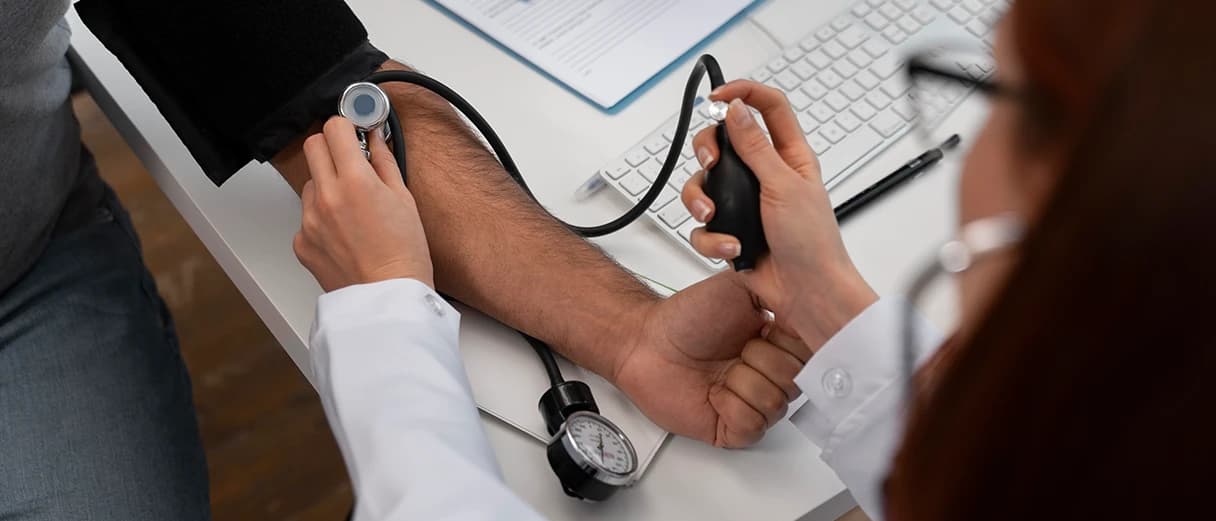
High blood pressure is the single most important risk factor for heart disease in India, and most of the people carrying it have no idea. There are no obvious symptoms for years. The damage happens quietly inside the walls of the arteries, the chambers of the heart, and the blood vessels of the brain until something breaks. By the time that happens, treatment is harder and outcomes are worse.
This post is for anyone in Borivali, Dahisar, Kandivali, Mira Road, or the surrounding suburbs of North Mumbai who has high BP, or thinks they might, or has a family history that puts them at risk. It covers what high BP does to the heart, what symptoms to take seriously, when to see a cardiologist, and what you can do right now.
India is in the middle of a cardiovascular disease epidemic. According to the WHO India factsheet on cardiovascular diseases, CVDs are responsible for 27 per cent of all deaths in India, and 45 per cent of deaths in the 40 to 69 age group. Hypertension is described as among the most important risk factors for CVD in low and middle income countries.
A 2025 systematic review and meta-analysis published in the International Journal of Environmental Research and Public Health, covering studies from 2000 to 2024, found that India accounts for one fifth of global CVD deaths, disproportionately affecting younger people. The pooled CVD prevalence in urban India was 12 per cent, double that of rural areas, which places Mumbai and the North Mumbai suburbs in a high-risk category.
Urban prevalence data is equally stark. A review published in the Journal of Human Hypertension documented hypertension rates among urban adults in Mumbai at approximately 44 per cent in men and 45 per cent in women. That is nearly one in two adults in the city.
The majority of those people are not in treatment. Many do not know they have it.
Understanding the mechanism matters, because it explains why blood pressure that feels fine is still dangerous.
Every time the heart beats, it pushes blood through the arteries. When blood pressure is high, it pushes against the arterial walls with more force than they are designed to handle. Over months and years, this wears down the lining of the arteries, makes them less flexible, and causes them to narrow. The medical term for this is atherosclerosis, or hardening of the arteries.
According to the American Heart Association, uncontrolled high blood pressure can directly lead to heart attack, heart failure, and stroke. It does so by blocking blood flow to the heart muscle, overworking the left ventricle until it thickens and weakens, and by rupturing or blocking blood vessels supplying the brain.
When blood pressure is consistently high, the heart has to pump harder with every beat to push blood through narrowed arteries. The left ventricle, the main pumping chamber, responds by thickening its walls, a condition called left ventricular hypertrophy. This thickening eventually makes the heart less efficient. The heart becomes stiffer, cannot fill properly, and starts to fail. Heart failure in India most commonly follows years of uncontrolled hypertension.
The kidneys regulate blood pressure partly by controlling fluid levels in the body. When blood pressure damages the small blood vessels in the kidneys, their ability to filter and regulate fluid weakens. This creates a feedback loop: kidney damage from high BP causes blood pressure to rise further, which causes more kidney damage. Patients from Mira Road or Goregaon who have both hypertension and kidney problems face a particularly difficult cycle to break without specialist intervention.
Concerned about your blood pressure or heart health? Book a consultation at Aarogyam Multispeciality Hospital, Borivali: book-appointment
High blood pressure itself rarely causes symptoms in the early stages. But once it begins affecting the heart or other organs, the body sends signals. These are the ones that should prompt an immediate call to a doctor or a visit to a clinic:
Persistent headaches, especially at the back of the head in the morning, that do not respond to usual pain relief
Chest discomfort, pressure, or tightness, whether constant or coming in waves, including pain that radiates to the jaw, shoulder, or left arm
Shortness of breath during light activity, climbing stairs, or even at rest
Palpitations: a feeling that the heart is racing, pounding, fluttering, or skipping beats
Dizziness or lightheadedness, particularly when standing up from a sitting or lying position
Unexplained fatigue that rest does not fix, particularly in women, for whom fatigue is one of the most commonly missed signs of cardiac stress
Swelling in the legs, ankles, or feet, which can indicate that the heart is not pumping efficiently and fluid is building up in the lower body
Visual disturbances: blurring, spots, or brief loss of vision
Even if these symptoms are mild or intermittent, they deserve a proper evaluation. Our specialist doctors at Aarogyam Multispeciality Hospital in Borivali see patients with exactly these presentations. A single clinic visit and a basic set of tests can provide a clear picture of where things stand.
Go to the emergency room immediately if you experience:
Chest pain lasting more than a few minutes, or pain that goes away and comes back
Sudden weakness, numbness, or paralysis on one side of the face, arm, or leg
Slurred speech, confusion, or sudden severe difficulty understanding language
A sudden, severe headache unlike any you have had before
Sudden loss of vision in one or both eyes
Blood pressure reading at or above 180/120 mmHg, with or without symptoms
These may indicate a heart attack, stroke, or hypertensive crisis. Do not wait. Call emergency services or go directly to the nearest hospital.
A general physician or family doctor can manage most cases of early, uncomplicated high blood pressure. But there are situations that call for specialist cardiology input. Based on clinical guidance from the Northwestern Medicine cardiology team and specialist practice guidelines, you should see a cardiologist if any of the following apply to you:
If you are already on one or more blood pressure medications and your readings consistently remain above 140/90 mmHg, this is called resistant hypertension. It may mean the current medication is not the right match for you, the dose needs adjustment, or there is an underlying cause such as kidney disease, a hormonal condition, or sleep apnoea that needs to be investigated. A cardiologist can order the right tests and restructure your treatment plan.
A diagnosis of hypertension without a baseline cardiac evaluation is an incomplete picture. An ECG, echocardiogram, and lipid profile together tell you whether the heart has already been affected. Many patients in Borivali and Kandivali go years on blood pressure tablets without ever having an echocardiogram. This is worth correcting.
High blood pressure becomes significantly more dangerous when combined with other risk factors. See a cardiologist if you have hypertension alongside any of the following: diabetes, high cholesterol, a history of smoking, obesity, a family history of heart attack or stroke before the age of 60, or chronic kidney disease. The combination of these factors multiplies risk in a way that cannot be managed with a single medication. See the treatments page at Aarogyam Multispeciality Hospital for the full range of cardiac and related services available under one roof in Borivali.
Even without symptoms, a baseline cardiac evaluation after the age of 40 is sound preventive practice, particularly for people with desk jobs, chronic stress, a sedentary lifestyle, or a family history of heart disease. An early normal baseline is valuable: it gives you something to compare future readings against, and it allows a doctor to catch gradual changes before they become clinical problems.
Any of the symptoms listed in the previous section, even if they seem occasional or explainable by stress or tiredness, should be assessed by a cardiologist if they are recurrent. The heart does not usually announce problems loudly. It whispers first.
Aarogyam Multispeciality Hospital, Borivali. 16 specialist departments. 33+ doctors. 15 years of trusted care in North Mumbai. Cashless treatment under 37+ insurance providers. Call +91 916 777 6600 or visit: hospital-in-borivali
When you visit a cardiologist for a blood pressure or heart health assessment, the evaluation typically goes beyond a single BP reading. Common tests include:
ECG (Electrocardiogram): Detects abnormal heart rhythms, signs of previous heart attacks, and early indicators of left ventricular strain. Quick, painless, and done in minutes.
Echocardiogram (2D Echo): An ultrasound of the heart that shows the structure and pumping function of the heart chambers and valves. This is the most important test for assessing whether long-term high blood pressure has affected the heart muscle.
Lipid Profile: A blood test measuring LDL cholesterol, HDL cholesterol, and triglycerides. High cholesterol combined with high blood pressure dramatically increases arterial risk.
Blood Glucose / HbA1c: Checks for diabetes or pre-diabetes, which frequently coexists with hypertension in urban Indian populations.
Kidney Function Tests (serum creatinine, eGFR): High blood pressure and kidney disease feed each other. These tests confirm whether the kidneys have been affected.
Ambulatory Blood Pressure Monitoring (ABPM): A portable monitor worn for 24 hours that records BP at regular intervals throughout the day and night. Useful when clinic readings are inconsistent or unusually high.
Not every patient needs every test. A cardiologist will assess which investigations are appropriate based on your history, your symptoms, and your existing readings.
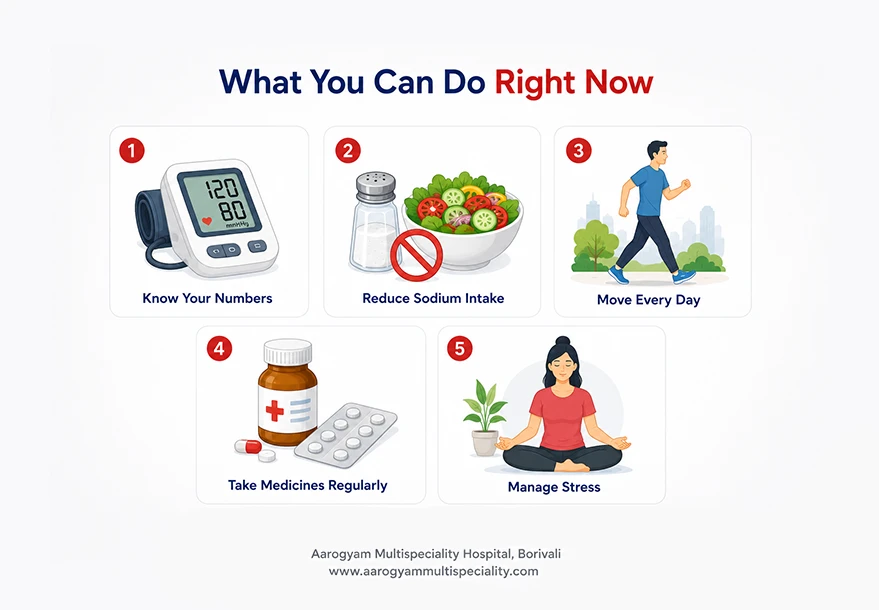
Treatment and lifestyle change together work far better than either alone. The following steps are evidence-based and relevant to patients in North Mumbai:
A digital blood pressure monitor is the single most useful health tool in any household where someone has hypertension or a family history of it. Check your blood pressure at the same time each day, in a seated position after five minutes of rest. Note the readings. A blood pressure diary is something your doctor will find genuinely useful at every consultation.
Most of the sodium Indian urban adults consume comes not from the salt shaker but from packaged foods, restaurant meals, pickles, papads, and processed snacks. Reducing sodium to under 2,300 mg per day (ideally closer to 1,500 mg for people with established hypertension) produces a measurable reduction in blood pressure. For patients in Borivali or Malad who eat out frequently, this is a practical and important change.
Thirty minutes of moderate physical activity, five days a week, lowers blood pressure and reduces cardiac risk. Walking, cycling, swimming, or yoga all count. The key is consistency over intensity. Patients who have been sedentary for a long time should get a cardiac clearance before starting a new exercise programme, but should not use that as a reason to delay starting.
Blood pressure medication works only when taken regularly. Missing doses, stopping treatment when readings improve, or adjusting doses without medical guidance are among the most common reasons blood pressure remains uncontrolled. If you are on medication and struggling with side effects, speak to your doctor about alternatives rather than stopping treatment.
Chronic stress contributes to sustained high blood pressure and worsens cardiac outcomes. This is not an abstract claim. Stress raises cortisol levels, increases inflammation, promotes unhealthy coping behaviours, and keeps the nervous system in a state of activation that keeps blood pressure elevated. Identifying practical stress management strategies, whether through sleep, exercise, social support, or structured relaxation, is a legitimate part of cardiac care.
If you have not had a heart health check recently and you have any of the risk factors mentioned in this post, the right time to act is now, not after symptoms develop. Aarogyam Multispeciality Hospital in Borivali serves patients from across North Mumbai, including Dahisar, Kandivali, Mira Road, Malad, and Goregaon. We have been operating for over 15 years, formerly as National Hospital Borivali, and bring 16 specialist departments under one roof. Our insurance page lists 37+ cashless empanelled providers. Call +91 916 777 6600 to book.
A reading of 140/90 mmHg or above, confirmed on two separate occasions, means you need medical evaluation. A reading of 180/120 mmHg or above is a hypertensive crisis and requires emergency attention, especially if accompanied by chest pain, shortness of breath, headache, or visual disturbance. For context, a normal adult reading is below 120/80 mmHg.
Yes. This is exactly the danger. High blood pressure damages arteries silently over years. You can feel completely well while your coronary arteries are narrowing and your heart is working harder than it should. The absence of symptoms does not mean the absence of damage. Regular monitoring and periodic cardiac evaluation are the only ways to know what is actually happening inside the cardiovascular system.
Yes, particularly if you have never had a baseline echocardiogram or lipid profile. Being on medication means your blood pressure is being treated, not that the heart has been evaluated. A cardiologist can assess whether the heart muscle has been affected, whether your current medication is optimal, and whether there are additional risk factors that need attention. Two years of stable BP medication is not the same as two years of comprehensive cardiac monitoring.
A heart attack occurs when a coronary artery becomes blocked and a part of the heart muscle is starved of blood. The person is usually conscious and in pain. A cardiac arrest occurs when the heart suddenly stops beating altogether, causing the person to collapse, become unresponsive, and stop breathing normally. A heart attack can trigger a cardiac arrest, but they are different events. Both require immediate emergency response.
The data suggests yes. A report in The Week based on cardiovascular disease trends in India noted that CVD cases in India escalated from 25.7 million in 1990 to 64 million in 2023, and that Indians tend to develop CVD risk factors at a comparatively younger age than other populations, with more severe manifestations. Sedentary lifestyles, chronic work stress, processed food, and rising rates of diabetes and hypertension in people in their 30s and 40s are all contributing. Heart disease is no longer something to think about only after 60.
