Virtual assistant · appointments & hospital info
Built by Simplifyne Technologies
Most women in Borivali, Dahisar, and Kandivali see a gynaecologist only when something is already wrong. A delayed period that has stretched into two months. Pain that is no longer manageable. A pregnancy that is already confirmed. The visit that should have happened weeks or months earlier keeps getting postponed, often because the symptom did not feel serious enough, or because there was no time, or because nobody ever explained when to go.
This post is a practical guide to that question. It covers the specific symptoms, life stages, and screening milestones that warrant a gynaecological consultation, and explains what each type of visit involves. Whether you are 22 or 52, whether you are managing PCOS or planning your first pregnancy or wondering what perimenopause actually feels like, knowing when to seek care is the most useful thing you can know.
Many women think of a gynaecologist as the doctor you see for pregnancy and periods. The scope is significantly broader. A gynaecologist is trained to assess and treat the full range of conditions affecting a woman's reproductive system, hormonal health, and pelvic organs across every stage of life.
This includes: menstrual disorders (irregular cycles, heavy bleeding, severe pain), polycystic ovary syndrome (PCOS), endometriosis, uterine fibroids, ovarian cysts, vaginal infections, urinary tract conditions, fertility concerns, contraception counselling, cervical and breast cancer screening, perimenopause and menopause management, and pregnancy care from conception through delivery.
You do not need to be pregnant, or to have a specific diagnosis, to make an appointment. Preventive visits, screening tests, and consultations for symptoms that feel unclear but persistent are all appropriate reasons to see a gynaecologist. Our doctors page lists the gynaecology team at Aarogyam Multispeciality Hospital in Borivali.
Book a gynaecology consultation at Aarogyam Multispeciality Hospital, Borivali: book-appointment | +91 916 777 6600
The following symptoms are common reasons women in North Mumbai delay seeking care, either because they seem manageable or because they have been present for so long that they feel normal. None of them are normal. Each warrants a gynaecological assessment.
A normal menstrual cycle falls between 21 and 35 days. Occasional variation is expected, particularly after illness, travel, or significant stress. When irregularity is persistent, meaning cycles that are consistently shorter, longer, or absent for more than three months, it is a signal that something in the hormonal system needs to be looked at.
A review of two decades of evidence on menstrual disorders in India, published in the Global Health journal in 2025 and conducted by researchers at the International Institute for Population Sciences in Mumbai, found that menstrual disorders are widespread among Indian women of reproductive age, with dysmenorrhea (painful periods) reported in up to 76 per cent of study populations. The same review found that only one-third of women with menstrual disorders sought medical care, despite evidence that untreated disorders increase the long-term burden of non-communicable diseases.
Common causes of irregular periods include PCOS, thyroid dysfunction, significant weight change, and stress. The only way to find out which is causing the problem is to have it assessed.
Bleeding heavily enough to soak through a pad or tampon every hour for two or more consecutive hours is not a variation to endure. Neither is bleeding that lasts longer than seven days, or passing large clots regularly. Heavy bleeding, known clinically as menorrhagia, can indicate uterine fibroids, adenomyosis, hormonal imbalance, or, in some cases, a polyp or other structural issue. It also leads to iron-deficiency anaemia over time if left unaddressed.
If you are managing heavy periods in Borivali or Mira Road by stocking up on sanitary products and rearranging your schedule around your cycle, that is not an acceptable long-term solution. It is a reason to be seen.
Mild cramping in the first one or two days of a period is common. Pain that is severe enough to limit daily activity, that begins days before a period and continues after it ends, that occurs outside of the menstrual cycle, or that is present during or after intercourse, is not normal and should be investigated.
Persistent pelvic pain can indicate endometriosis, ovarian cysts, pelvic inflammatory disease (PID), or other conditions. Endometriosis in particular is significantly underdiagnosed in India, partly because severe menstrual pain has historically been dismissed as something women are expected to tolerate.
Normal vaginal discharge is clear or white, odourless or mildly scented, and varies in volume across the menstrual cycle. Discharge that is yellow, green, or grey; that has a strong, unpleasant odour; that is associated with itching, burning, or pain; or that is significantly heavier than usual can indicate a bacterial or yeast infection, a sexually transmitted infection, or another treatable condition. These do not resolve on their own and should not be self-treated without a diagnosis.
Spotting between periods occasionally can be related to ovulation or hormonal fluctuation and is often benign. Bleeding that is regular or heavy between periods, or any vaginal bleeding that occurs after menopause has been confirmed, requires prompt medical evaluation. Post-menopausal bleeding is never normal and should always be investigated without delay.
See a gynaecologist urgently if you have:
• Any vaginal bleeding after menopause
• Sudden, severe pelvic or lower abdominal pain
• Fever with pelvic pain or unusual discharge (may indicate pelvic inflammatory disease)
• A lump or unusual swelling in the lower abdomen
• Significant bleeding between periods that is getting heavier over time
These symptoms need assessment, not a wait-and-see approach.
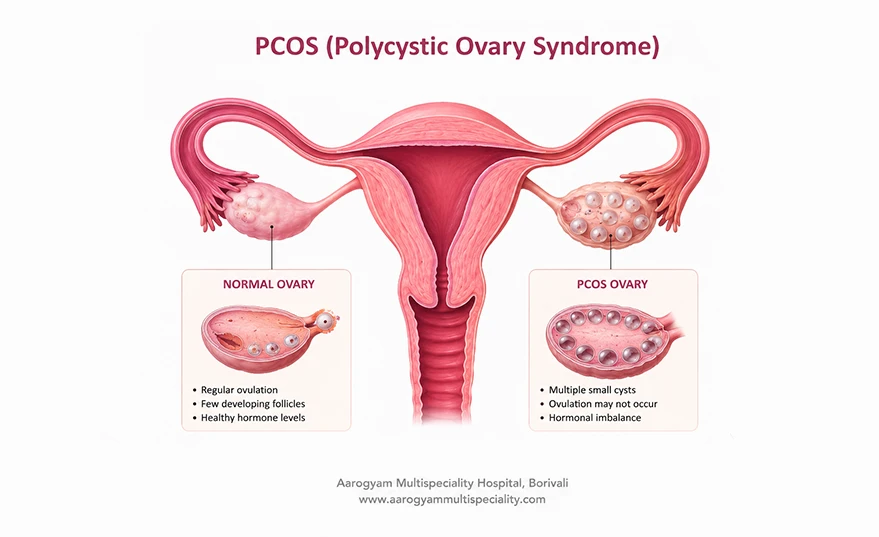
Polycystic ovary syndrome is one of the most common hormonal conditions affecting women of reproductive age in India. Research published in PMC estimates that PCOS prevalence among Indian women ranges from approximately 3.7 to 22.5 per cent depending on diagnostic criteria and population studied, making it a condition that affects a very large number of women in every neighbourhood in North Mumbai.
Despite this prevalence, it is consistently underdiagnosed. Many women with PCOS are told their irregular periods are due to stress, or are given a contraceptive pill without a formal investigation into the underlying hormonal imbalance. This matters because PCOS is not only a reproductive condition. It is linked to insulin resistance, a higher lifetime risk of type 2 diabetes, elevated cardiovascular risk, and, in some cases, difficulty conceiving.
Symptoms to watch for include irregular or infrequent periods, unexpected weight gain (particularly around the abdomen), acne in adulthood that does not respond to usual treatment, excess facial or body hair, thinning of scalp hair, and persistent fatigue. You do not need to have all of these to warrant a PCOS assessment. Two or three of these symptoms together, especially with irregular cycles, is enough reason to be seen.
PCOS is assessed through a combination of blood tests (hormonal profile, fasting glucose, insulin), ultrasound of the ovaries, and clinical review of symptoms. It is manageable with the right guidance, and early intervention significantly reduces the long-term metabolic risks. For further information about the investigations and treatments available, visit our treatments page.
Concerned about irregular periods, weight changes, or PCOS symptoms? Get assessed at Aarogyam Multispeciality Hospital, Borivali. Call +91 916 777 6600 or visit book-appointment.
Cervical cancer is the second most common cancer among women in India. According to GLOBOCAN 2022 data, India recorded approximately 127,500 new cases of cervical cancer in that year, and nearly 80,000 deaths. India's age-standardised mortality rate for cervical cancer is approximately 11.2 per 100,000 women, significantly higher than the global average of around 7.1 per 100,000.
What makes these numbers particularly troubling is that cervical cancer is one of the most preventable cancers when caught early. The problem in India is that screening rates remain very low. A 2025 review published in the Asian Pacific Journal of Cancer Prevention found that only 1.9 per cent of women aged 30 to 49 in India had undergone cervical cancer screening as of the 2019-21 national survey period. This is not a knowledge gap alone. It is a reflection of how infrequently women access gynaecological care for routine preventive purposes.
The ICMR and international screening guidelines recommend that women aged 30 years and above undergo a Pap smear once every three years. If the Pap test is combined with an HPV (Human Papillomavirus) test, the interval can be extended to five years. Screening should continue until age 65 in the absence of abnormal results. Women who have received the HPV vaccine still require screening, as the vaccine does not protect against all strains of HPV associated with cervical cancer.
A Pap smear is a straightforward procedure done during a gynaecological examination. It takes only a few minutes, involves mild discomfort at most, and can detect changes to cervical cells before they develop into cancer. Early-stage cervical cancer has high survival rates. Late-stage diagnosis does not. The case for screening is as clear as it gets.
If you are over 30 and have not had a Pap smear in the last three years, that is reason enough to book an appointment. Our team at Aarogyam in Borivali can provide cervical cancer screening alongside a full gynaecological health check. See our hospital page for more on the services we offer.
A preconception consultation is one of the most underused but valuable gynaecological appointments available to women in Mumbai. If you are planning to become pregnant in the next 6 to 12 months, visiting a gynaecologist before you stop contraception allows you to address factors that could affect conception or early pregnancy while there is still time to act on them.
A preconception visit typically involves a review of your general health, menstrual history, and any current medications; assessment of conditions like thyroid disease, diabetes, or anaemia that should be managed before pregnancy; checking immunity status for rubella; reviewing folic acid supplementation (recommended for all women planning pregnancy to reduce the risk of neural tube defects); and discussing timing, cycle tracking, and what to expect in early pregnancy.
Women who have been trying to conceive for 12 months without success (or 6 months if they are over 35) should be seen by a gynaecologist for a fertility workup. This is not a reason to panic. It is a routine step that helps identify whether there is a hormonal, structural, or other issue that can be addressed.
Once pregnancy is confirmed, the first antenatal appointment should be made as early as possible, ideally before 10 weeks. Early pregnancy care helps confirm your pregnancy, accurately estimate your due date, rule out ectopic pregnancy, and assess your overall maternal health. At Aarogyam, our Gynaecology & Obstetrics specialist provides expert evaluation, guidance, and personalised care for women during the early stages of pregnancy.
Planning a pregnancy or already expecting? Aarogyam Multispeciality Hospital, Borivali serves families from Dahisar, Kandivali, Malad, Goregaon, and Mira Road. Book an appointment: book-appointment
Perimenopause, the transitional phase leading to menopause, typically begins in a woman's mid-to-late 40s, though it can start earlier. Menopause itself is confirmed after 12 consecutive months without a menstrual period. The average age of menopause in India is somewhat lower than in Western populations, and a PMC-published review in 2025 noted that factors such as surgical menopause, low income, and rural living contribute to premature menopause in a meaningful proportion of Indian women.
The symptoms of perimenopause are often dismissed or attributed to stress or ageing, which delays women from seeking care. Common symptoms include irregular periods (often the first sign), hot flushes, night sweats, sleep disturbances, mood changes including anxiety and low mood, vaginal dryness, reduced libido, and joint or muscle pain. A study on perimenopausal women in urban India found that fatigue, hair loss, and joint or body pain were among the most commonly reported symptoms, though many women did not associate them with hormonal transition.
Menopause is not an illness and does not always require medical treatment. But its effects on bone density, cardiovascular risk, and quality of life are real and manageable. Women who are experiencing symptoms that are affecting their sleep, mood, or daily functioning should not simply endure them. A gynaecologist can assess what is happening hormonally, discuss options including lifestyle changes, hormonal and non-hormonal therapies, and help each woman make an informed decision based on her own health profile.
Any bleeding that occurs after menopause has been confirmed must be investigated without delay, regardless of how minor it seems. Post-menopausal bleeding is always a reason to be seen promptly.
The honest answer is that most women in Borivali, Dahisar, and the rest of North Mumbai are not seeing a gynaecologist often enough. A gynaecological check-up is not just for when something is wrong. It is a routine part of women's healthcare at every age.
Annual visits are appropriate if you are sexually active or have menstrual concerns. A gynaecologist can discuss contraception, screen for infections, and provide guidance on cervical health. Women from age 21 onward can begin cervical cancer screening conversations with their doctor.
Cervical cancer screening with a Pap smear every three years should be part of routine care from age 30. This is also the decade when PCOS, fibroids, and thyroid-related menstrual changes often become more apparent. If you are planning a pregnancy or have been trying to conceive without success, your 30s are the time to be proactive rather than waiting.
Continue Pap smear screening. Watch for signs of perimenopause and do not dismiss new symptoms as simply part of getting older. Bone health, cardiovascular risk, and breast health become increasingly relevant preventive concerns. A clinical breast examination every one to three years is recommended by ICMR guidelines as part of breast cancer early detection.
Menopause management, bone density monitoring, cardiovascular health, and continued cancer screening are the priorities. Any post-menopausal bleeding requires same-week evaluation. Regular gynaecological visits remain relevant even when periods have stopped.
We accept cashless treatment under 37 insurance providers at Aarogyam, which means routine gynaecological care does not need to be delayed for financial reasons. Check whether your policy is covered at our insurance page.
Aarogyam Multispeciality Hospital, Borivali. 16 specialist departments. 33+ doctors. Formerly National Hospital Borivali, serving North Mumbai for over 15 years. Call +91 916 777 6600 or visit hospital-in-borivali.
It is never too late. Women at any age benefit from gynaecological care, whether they are managing an active concern, due for a Pap smear, approaching menopause, or simply wanting a baseline health check. If you have never had a pelvic examination or cervical screening and you are over 30, booking an appointment now is the most important step you can take for your long-term gynaecological health. The consultation at Aarogyam is private, and our team is experienced in speaking with women at every stage of life, including those who are attending for the first time.
Yes. Irregular periods without pain are still worth investigating, particularly if the irregularity is consistent, if cycles are very short (fewer than 21 days), very long (more than 35 days), or if you are missing periods for months at a time. PCOS and thyroid disorders can both cause irregular periods without significant pain. A short consultation and a blood test can identify whether there is a treatable underlying cause, which is far better than discovering it later when you are trying to conceive or when metabolic consequences have already developed.
A routine visit typically includes a discussion of your menstrual history, general health, contraception, and any symptoms; a physical examination including a pelvic examination if appropriate; a Pap smear if you are due for one; and any relevant blood tests (such as hormonal profile, thyroid, blood sugar, or iron if indicated). Your doctor will explain each step before proceeding. The visit is usually completed within 30 to 45 minutes. You can ask any question during the consultation: a good gynaecologist will address it without dismissal.
Ideally, before you start trying. A preconception consultation allows your doctor to check your general health, review any medications that might need adjustment, confirm your folic acid supplementation is in place, and identify any underlying conditions such as thyroid disease or anaemia that should be managed before pregnancy. If you are already pregnant, your first appointment should be before 10 weeks. Early confirmation of pregnancy, accurate dating, and ruling out complications such as ectopic pregnancy are all important in the first trimester.
If pelvic pain is severe enough to make you take a painkiller, change your plans, or restrict your movement, it is serious enough to see a doctor about. Pain that occurs outside of your period, that lasts more than two or three days, that comes with fever, or that is worsening over time should not be managed with over-the-counter medication alone. If you experience sudden, severe pelvic or lower abdominal pain, seek immediate medical attention. Our team at Aarogyam is available to assess gynaecological concerns at our Borivali facility, which is accessible to patients from Mira Road, Kandivali, Goregaon, and Malad.
